How to optimise for citations in ChatGPT Search?
Article Summary
To optimise for citations in ChatGPT Search, you must shift from traditional keyword targeting to Generative Engine Optimisation (GEO). This involves explicitly allowing the OAI-SearchBot in your site's robots.txt file, writing highly fact-dense "answer capsules" in the first 30 percent of your webpage, and updating your content monthly. In 2026, roughly 31 percent of ChatGPT prompts trigger a live web search (rising to 59 percent for local queries), making it crucial to structure your data for AI extraction rather than just human browsing.
Need results? Ask an expert
What is Generative Engine Optimisation (GEO)?
The search landscape has fundamentally changed. As AI tools increasingly provide complete answers directly within the chat interface, many businesses are facing a steep drop in traditional website visits. In fact, relying solely on old-school tactics is no longer enough when 48 percent of UK adults now use AI-assisted tools for daily information gathering. This shift requires Generative Engine Optimisation (GEO), the practice of formatting your digital footprint specifically so Large Language Models (LLMs) can read, trust, and cite your brand.
Interestingly, ChatGPT Search operates on an entirely different playing field than standard search engines. Approximately 90 percent of its citations come from pages that rank at position 21 or lower in standard Google search results. It prioritises direct answers over traditional ranking authority. If you want to get your business listed in ChatGPT, you need to rethink your approach to information delivery, focusing purely on clarity and factual density.

Technical Requirements for ChatGPT Search
Before an AI can cite your website, it has to be allowed to read it. The most critical technical step for ChatGPT visibility is updating your site protocols. Publishers must explicitly allow the OAI-SearchBot in their robots.txt file to be eligible for real-time search citations. It is important to note that this is distinct from the GPTBot, which is used for general, historical model training rather than live search retrieval.
Additionally, forward-thinking UK B2B firms are adopting dual-optimisation strategies to ensure their technical foundations are flawless. This includes exploring emerging standards like the llms.txt file implementation, which provides a clean, markdown-based summary of your site's core information directly to AI crawlers, bypassing complex website code.
Losing traffic to zero-click AI answers? We solve this. See how
Structuring Content for AI Extraction
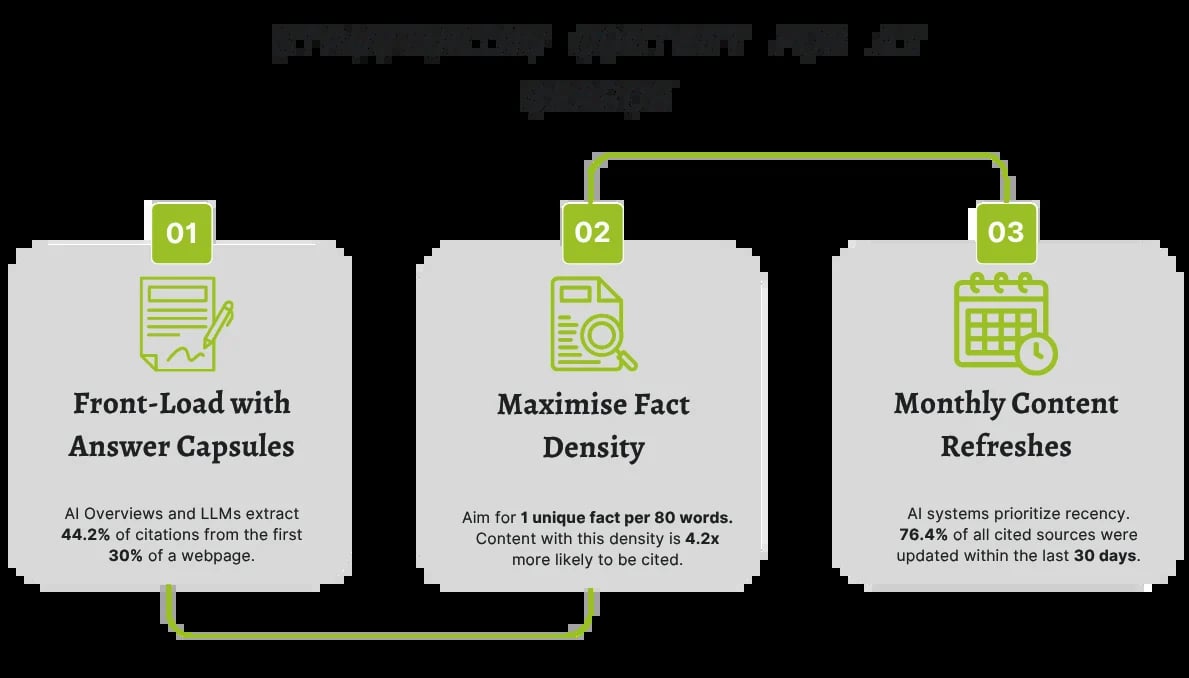
AI models do not read pages the way humans do; they scan for immediate, verifiable information. Statistical analysis shows that 44.2 percent of citations are extracted from the first 30 percent of a webpage. To capitalise on this, you need to create "answer capsules", concise, highly informative paragraphs placed right at the top of your page. This front-loaded formatting is also how you get featured in Google AI Overviews, making it a powerful tactic for multiple search engines.
Beyond placement, your writing style must adapt. Pages maintaining a fact density of at least one unique fact per 80 words are 4.2 times more likely to be cited than content focused on narrative or marketing prose. Cut the fluff and deliver the data. Furthermore, AI algorithms display a massive recency bias. Data from early 2026 indicates that 76.4 percent of cited pages were updated within the 30 days prior to the search. A "set it and forget it" content strategy will no longer work; regular, factual updates are mandatory.
Measuring Success in a Zero-Click World
Tracking return on investment is notoriously difficult when AI models synthesise information from multiple sources without driving a direct click to your domain. To adapt, marketers must shift away from standard click-through rates and embrace Share of Model (SoM) Analytics. This involves tracking how often your brand name or unique data points are mentioned in AI responses across your core topical areas.
Be prepared for a bumpy ride. Internal agency data shows that AI citations are highly volatile, with less than 1 percent of sources remaining consistent across repeated identical search queries. Navigating these unpredictable changes requires a future-proof SEO strategy that balances traditional search revenue with emerging AI visibility.
FAQs
Ready to dominate AI search results?
Join leading UK brands by partnering with a true 5-Star SEO Agency. We leverage predictive trend analysis to keep you ahead of the digital curve and provide 100% transparent reporting so you can watch your Share of Model grow. Stop losing traffic to zero-click answers.